


Views: 0 Author: Site Editor Publish Time: 2026-09-12 Origin: Site


Asking for a single lifting capacity figure is a very common starting point for equipment procurement. However, it represents a highly flawed approach. Lifting capacity simply does not exist as a static number. Instead, it operates as a dynamic curve dictated by physics, engineering tolerances, and your specific truck configuration. To correctly spec a machine and avoid dangerous under-sizing or costly over-purchasing, you must look beyond top-line maximums. Buyers should carefully evaluate load charts, weight-to-lift ratios, and chassis compatibility. A crane might lift 10 tons right next to the bumper. It may only lift a fraction of this weight at full extension. Understanding this reality separates successful fleet deployments from expensive operational failures. In this guide, we will explore exactly how these lifting capacities work. You will learn to decode load charts, evaluate capacity classes, and match the right equipment to your daily job site demands.
Capacity Range: Commercial knuckle boom cranes typically lift anywhere from 1,000 lbs (light-duty) to over 60,000 lbs (heavy-duty) at close range.
The Core Metric: True capacity is measured in Ton-Meters (t/m) or Foot-Pounds (ft-lbs), dictating how much weight can be lifted at specific horizontal distances.
The Golden Rule: Lifting capacity decreases exponentially as the articulated boom extends further from the center pedestal.
Payload Efficiency: A primary commercial advantage is their high weight-to-lifting ratio, allowing for maximum truck payload retention compared to straight-boom alternatives.
Buyers often select a crane based on an isolated maximum lift requirement. This single-minded focus leads to highly inefficient fleet utilization. A company might buy a massive unit just for one rare job. They then haul around dead weight every other day. Evaluating equipment by class ensures better alignment with your daily operational demands. We break these down into three primary categories to simplify procurement.
These compact units are best for municipal maintenance, light construction, and standard delivery trucks. Their typical maximum lift ranges from 1,000 to 5,000 lbs at minimum reach. The main commercial value lies in fast deployment. They require a minimal chassis footprint. You can often mount them on standard commercial trucks without upgrading to heavy-duty axles. This preserves vital space for cargo. Operators use them frequently for moving pallets, small pipes, and landscaping materials. A well-sized light-duty Knuckle Boom Crane dramatically speeds up urban deliveries while keeping fuel consumption low.
These units handle roofing materials, mid-size logistics, and general utility work perfectly. You can expect a typical maximum lift between 5,000 and 15,000 lbs at minimum reach. Industry experts often call this category the "sweet spot" for versatility. They offer serious lifting power without requiring specialized, heavy-permit commercial chassis. Mid-range units dominate the building supply sector. They lift drywall bunks and lumber stacks directly to upper floors. The balance of lifting power and compact truck size makes them highly attractive for contractors.
You need these machines for major infrastructure projects, heavy machinery moving, and tough forestry applications. Their typical maximum lift spans from 20,000 to over 60,000 lbs near the pedestal. Their sheer commercial value is immense. They can often replace traditional mobile cranes on tight job sites. Yet, they still retain normal payload transport capabilities. Heavy-duty models require multi-axle trucks to handle the massive frame stress. They also demand rigorous operator training. However, they deliver unparalleled horizontal reach for massive payloads in complex environments.
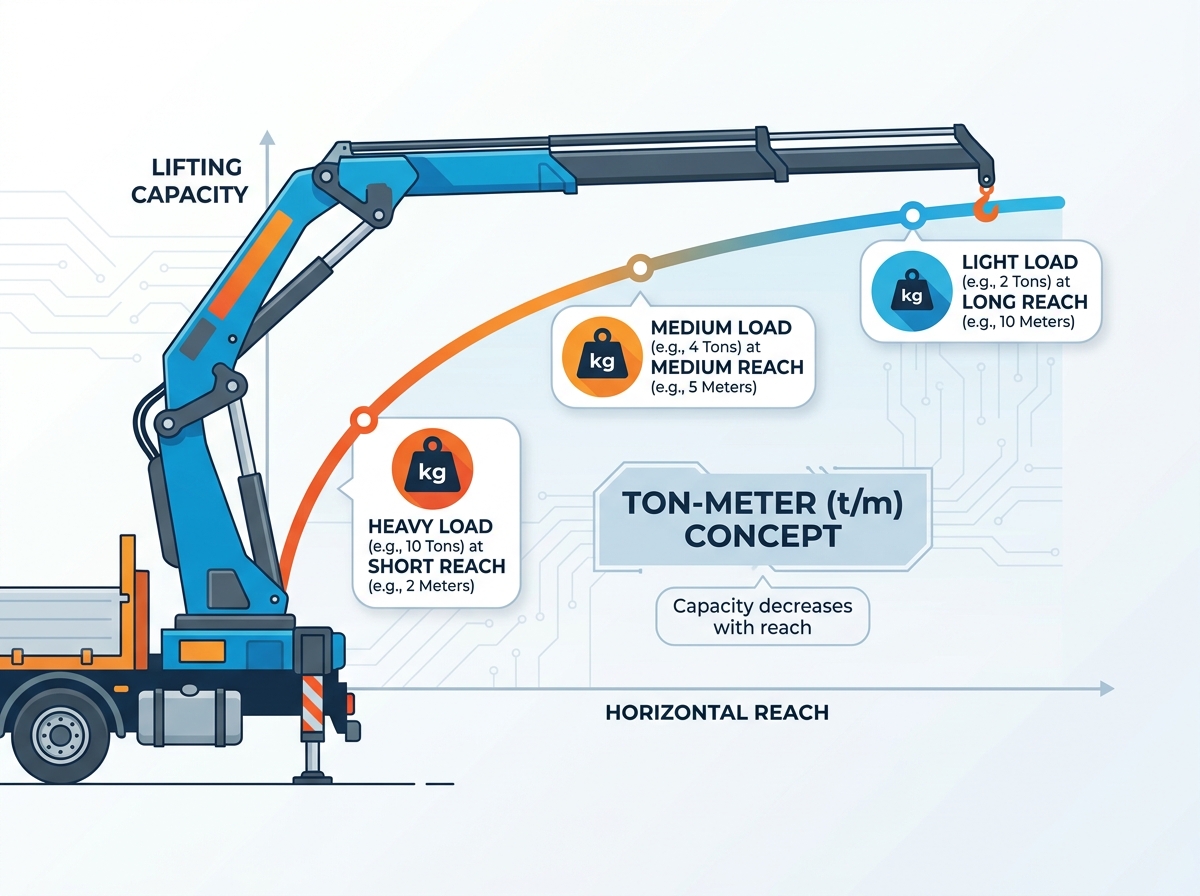
Sales brochures usually highlight the absolute maximum lift right next to the pedestal. This number looks great in marketing materials. However, the load chart reveals a different story. It shows what the crane can actually lift at your job site's required distance. You must understand this chart before buying any equipment.
The industry measures true capability in Ton-Meters. We define this using a simple formula: Weight × Distance = Lifting Moment. This metric dictates machine stability and structural strength. Consider a typical 20 t/m crane. It can lift 10 tons at a 2-meter distance. Alternatively, it can lift 2 tons at a 10-meter distance. The math scales proportionally across the entire working radius.
Example Lifting Capacities for a 20 t/m Crane
Distance from Center (Meters) | Estimated Lifting Capacity (Tons) | Lifting Moment (t/m) |
|---|---|---|
2 | 10.0 | 20 |
4 | 5.0 | 20 |
5 | 4.0 | 20 |
10 | 2.0 | 20 |
The primary load curve drops sharply as you extend the hydraulic arms. The inclusion of jibs or manual extensions alters this curve even further. We call this the "derating" effect. As hydraulic sections extend outward, the weight of the boom itself consumes available lifting capacity. The further you reach, the less payload you can support. Modern units feature Load Moment Indicators to prevent catastrophic overloading. Physics strictly dictates this reality. You must always consult the chart for the specific reach you need on-site. Never guess based on the maximum rated figure.
Buyers constantly weigh articulated models against traditional straight booms. Both types have distinct places in modern fleets. However, articulated units provide unique advantages for logistics and transport companies aiming for maximum daily efficiency.
Manufacturers build these articulating units from advanced high-tensile steel. This specialized material makes them much lighter than comparable straight, telescopic booms. The outcome is highly beneficial for fleet operators. Less equipment weight equals more legal payload capacity on the truck bed. You can carry more goods per trip. This directly impacts your daily logistics profitability. Every extra pound of equipment reduces your billable cargo by a pound. Integrating an optimized Knuckle Boom Crane preserves your valuable deck space for actual freight.
Straight booms require significant vertical clearance. They must angle high into the air to lift a load over a nearby obstacle. This becomes a nightmare in confined urban environments. Power lines and low bridges create instant hazards. Knuckle booms operate quite differently. They can articulate, or "knuckle," in mid-air. This action allows them to lift heavy materials horizontally. You can snake payloads through tight spaces, open doorways, or under low ceilings. This unmatched flexibility solves major logistical headaches on crowded construction sites.
Your crane will not operate in a vacuum. Real-world conditions restrict performance heavily. Understanding these hidden factors prevents accidents and protects your capital investment.
A crane can only lift safely if the truck chassis is strong enough. The vehicle must be heavy and structurally rigid. This prevents the entire rig from tipping over during a lift. Putting a massive 40 t/m unit on an undersized axle rating compromises the entire setup. The Gross Vehicle Weight Rating (GVWR) must align perfectly with the lifting moment. Engineers must calculate the torsional stiffness of the truck frame. If the frame flexes too much under load, the system will eventually fail.
Manufacturers base 100% load chart capacity on ideal conditions. This assumes 100% horizontal stabilizer extension. It also assumes you are parked on level, perfectly firm ground. Confined urban spaces often prevent full extension. You might only get the outriggers halfway out due to traffic lanes. This instantly derates your lift capacity. Advanced electronic systems will physically lock you out of heavier lifts if stabilizers are not fully deployed. Ground pressure also matters. Sinking into mud reduces stability and immediately lowers safe lifting thresholds.
Where you lift matters just as much as what you lift. Lifting over the rear or sides of a truck yields different capacities. Lifting over the cab is notoriously weak. The center of gravity shifts dramatically based on your vehicle's axle configurations. Front axles handle far less weight than tandem rear axles. You must check the specific zone chart for your truck to know your true operational limits.
Adding a winch provides excellent straight up-and-down lifting. It mimics a traditional mobile crane perfectly. However, it carries a severe penalty. The winch subtracts its own weight from the total available payload capacity. The heavy steel cable and the pulley block also add dead weight at the boom tip. If you rely on a standard hook, you keep this capacity for your actual cargo. You must decide if vertical precision is worth the payload penalty.
Choosing the right equipment requires a structured approach. Avoid emotional purchases based on aggressive marketing. Stick to cold math and daily operational realities. We recommend following a strict shortlisting logic.
Step 1: Identify the "Worst-Case" Lift. Determine the absolute heaviest object you must move regularly. Next, measure the maximum horizontal distance from the truck's centerline it must be placed. This establishes your absolute baseline requirement.
Step 2: Factor in Attachments. Calculate the dead weight of your tools. Grapples, rotators, and heavy pallet forks are not weightless. You must subtract their weight from the published load chart. What remains is your true lifting allowance for cargo.
Step 3: Consult Engineering and Dealership Data. Do not rely solely on generalized sales brochures. Request a formal stability calculation. Ask your dealer to run this math based on your specific truck make, model, and wheelbase.
You need to audit your current fleet before making a purchase. Check your existing chassis ratings carefully. Compile a detailed list of standard payload weights you move daily. Document the typical delivery environments you encounter. Once you have this hard data, engage a manufacturer for a formal quote. Thorough preparation ensures you buy the exact capacity you need.
A knuckle boom crane's true lifting capability goes far beyond a single maximum number. It is defined by a delicate intersection. Weight, reach, and vehicle stability all play equal parts. Physics strictly limits what you can move at extended distances. Understanding the difference between light, medium, and heavy-duty classes prevents poor allocation of capital.
You must invest time in understanding load charts. You must match the equipment perfectly to a capable truck chassis. Doing so prevents catastrophic operational failures. It maximizes equipment efficiency on every single job. When you respect the engineering limits, these machines become the most versatile lifting tools in your entire fleet.
A: Specialized, ultra-heavy knuckle booms can lift in excess of 30 to 40 tons at close range. However, standard commercial models typically peak between 2 and 15 tons. Maximum weight is always achieved when the load is positioned directly next to the central pedestal.
A: It is the core unit of lifting moment. You calculate it by multiplying the weight of the load by the distance from the crane center. A 20 ton-meter rating means it can lift 10 tons at 2 meters, or 2 tons at 10 meters. It forms the standard baseline for comparing different models.
A: Generally, no. Standard mobile cranes possess higher absolute lifting capacities and maximum vertical heights. However, knuckle booms offer vastly superior payload retention on the truck bed. They also provide unmatched transportability and the unique ability to articulate horizontally under low clearances.


