


Views: 0 Author: Site Editor Publish Time: 2026-09-20 Origin: Site


Industry professionals frequently confuse articulating equipment terminology. Words like "articulating" and "knuckle" sound virtually identical on active job sites. Both machine types use jointed arms to achieve impressive up-and-over reach. However, their fundamental engineering purposes differ completely. Choosing the wrong equipment creates severe safety risks for your crew. It triggers immediate regulatory compliance failures. You might face costly OSHA or ANSI violations. It also complicates your operational efficiency unnecessarily. You need a clear, evidence-based evaluation framework. Fleet managers, procurement officers, and site supervisors must select the right asset. You base this choice entirely on payload intent and site mobility. This guide explores the critical differences between these machines. We evaluate payload limits, ground conditions, and strict compliance boundaries. You will learn how to match machine capabilities directly to your daily operational goals.
Primary Function dictates choice: A truck mounted knuckle boom crane is purpose-built for heavy material handling and payload placement. An articulating boom lift (MEWP) is designed strictly for elevating personnel and light hand tools.
Mobility differences: Truck mounted cranes self-transport to jobsites at highway speeds, whereas boom lifts require a separate flatbed/trailer for transport but offer superior low-speed maneuverability on rough site terrain.
Compliance boundaries: Lifting materials with a personnel boom lift is generally prohibited and voids warranties, while adding a personnel basket to a knuckle boom crane triggers stringent, highly regulated compliance requirements.
Cost structures: Knuckle boom cranes carry a higher initial capital expenditure but consolidate transport and lifting into one vehicle, often yielding a better ROI for multi-site daily operations.
A Knuckle Boom Crane operates as a highly specialized hydraulic loader. Manufacturers mount it directly onto a heavy commercial truck chassis. This specific integration creates a powerful material handling asset. Professionals often call them articulating cranes. They feature multiple hydraulic extensions. These extensions fold compactly into themselves behind the truck cab. You will notice heavy-duty winch integration on many modern models. They rely entirely on robust outriggers for stabilization during lifts. Operators must consult specific load charts meticulously before acting. The primary use case involves heavy payload placement. You load, transport, and precisely place materials. Common payloads include heavy steel beams and large concrete forms. They also move palletized building supplies efficiently across construction sites. The machine powers these hydraulic movements through a Power Take-Off (PTO) system. This system draws mechanical energy directly from the truck engine.
An articulating boom lift serves a completely different engineering purpose. The construction industry often calls them cherry pickers or MEWPs. MEWP stands for Mobile Elevating Work Platform. These machines feature a dedicated, self-propelled chassis. You can choose wheeled or tracked variations for different terrains. The core defining feature is the personnel basket. This basket includes integrated control panels. Operators drive and maneuver the machine directly from this elevated platform. Many models offer highly requested zero-tailswing options. This feature allows safe rotation in tightly confined spaces. However, they have strictly limited weight capacities. A standard MEWP holds only 500 to 1,000 pounds maximum. The primary use case focuses solely on human access. They provide safe aerial access for workers. You use them for detailed tasks at height. Examples include electrical repair, tree trimming, and facility maintenance. They utilize dedicated battery packs or small diesel engines for power.
Core Equipment Specifications Summary
Specification | Articulating Crane | Articulating Boom Lift |
|---|---|---|
Primary Payload | Heavy materials and supplies | Personnel and light hand tools |
Chassis Type | Commercial truck chassis | Self-propelled base (wheeled/tracked) |
Stabilization Method | Hydraulic outriggers | Heavy counterweight base |
Capacity Range | Thousands of pounds | 500 to 1,000 pounds |
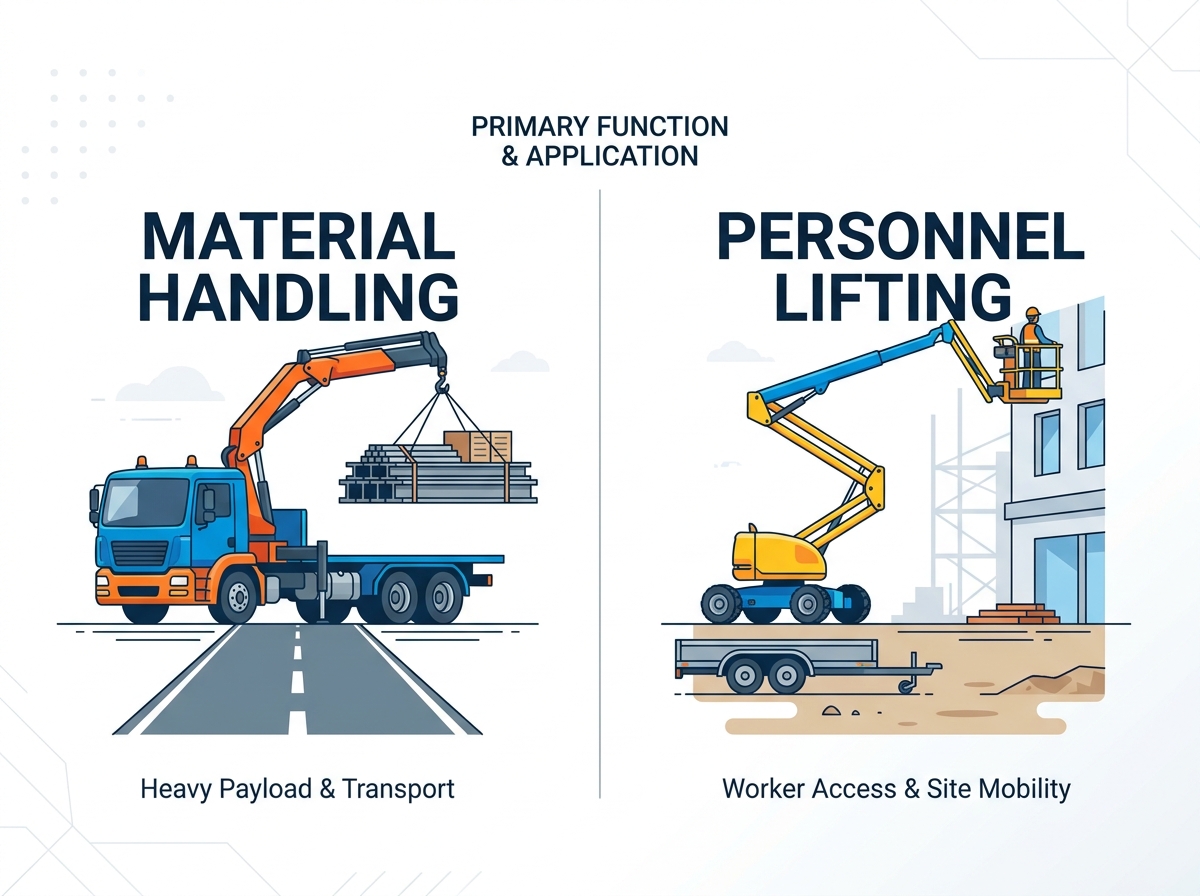
Payload intent represents the most critical dividing line. A Knuckle Boom Crane lifts thousands of pounds effortlessly. Success relies entirely on understanding the precise load radius. Operators must read specific lift charts before hoisting any object. As the hydraulic boom extends outward, lifting capacity decreases rapidly. You must calculate the exact weight of your material first. You cannot guess payload weights during heavy material handling. Boom lifts face much stricter capacity limits. You can usually elevate one or two workers safely. They can bring basic hand tools into the basket. If you overload a boom lift basket, the safety sensors trigger. The machine will instantly lock out all operational functions. This internal safety mechanism prevents catastrophic tipping accidents. You cannot override these safety sensors on modern equipment.
Next, you must evaluate your site footprint and ground conditions. Stabilization requirements vary drastically between these two machines. Cranes require adequate open space to deploy their outriggers. These outriggers manage immense ground pressure during heavy lifts. You must use appropriate outrigger pads beneath the stabilizing legs. Pads distribute the heavy machine weight over soft terrain safely. If the ground shifts unexpectedly, the crane could overturn. Boom lifts generally operate entirely without outriggers. They utilize a heavy counterweight base instead for overall stability. This unique design allows them to maneuver through tight spaces. You can drive them across active job sites easily. They handle rough, muddy terrain extremely well if equipped with tracks. You must monitor the ground incline continuously. Boom lifts have strict slope tolerance limits for safe operation.
Reach profiles also dictate your final equipment selection. We must compare the articulation geometry carefully. Boom lifts excel heavily in vertical "up-and-over" positioning. You can navigate them perfectly into highly confined spaces. They fit smoothly between complex building rafters or roof trusses. The operator can articulate the basket precisely around overhead obstacles. This makes them perfect for complicated facility maintenance. Cranes offer far superior horizontal reach instead. They excel at sub-grade lifting capabilities on deep foundation sites. You can reach over high walls effortlessly to place materials. Operators frequently drop concrete forms deep into foundation pits. The robust boom geometry supports heavy weights at these extreme angles. It provides unmatched versatility for raw material placement.
Cross-application creates severe operational dangers for everyone on site. You must never use equipment for unintended engineering purposes. Many contractors make a fatal mistake here. They rig heavy materials directly beneath a boom lift basket. This practice alters the machine's precise center of gravity drastically. It violates basic safety standards and manufacturer guidelines immediately. Slinging heavy loads beneath a MEWP basket voids your warranty. It stresses the internal hydraulic cylinders beyond their design limits. Tipping over becomes a highly probable, catastrophic outcome. These machines rely on delicate counterweight balance. You disrupt this balance when you use them as cranes.
Conversely, contractors often want to attach baskets to their cranes. You can technically pin personnel baskets to an articulating crane. However, this transitions the machine into a highly regulated space. OSHA strictly governs this practice under 29 CFR 1926.1431. You face massive implementation friction immediately upon doing this. The crane must feature specific redundant safety systems. You must install engineered pilot check valves. Operators must conduct rigorous trial lift protocols. They must perform these trials before elevating any workers. These strict regulations exist to prevent fatal falls. We highly recommend avoiding this practice unless absolutely necessary. It requires excessive paperwork and continuous safety oversight.
Operator certification requires completely distinct training paths. Adopting a new class of equipment demands significant time investment. NCCCO manages national certifications for crane operators. This complex training takes weeks and requires difficult written exams. Candidates must pass demanding practical operating tests. You must factor in training downtime for your crew. MEWP operator training moves much faster by comparison. Boom lift certification usually takes only one or two days. You still must maintain detailed training records for OSHA compliance. Both machines require mandatory daily pre-shift inspections. You cannot simply swap operators between machines without proper cross-training. An expert MEWP operator rarely understands complex crane load charts. You must respect the unique skill sets required.
You need a clear, actionable decision framework. We recommend analyzing your specific daily project metrics carefully. This prevents dangerous cross-application errors.
Your primary success metric involves moving heavy materials safely.
You require rapid multi-site mobility on a single day.
You want a single vehicle for transportation and lifting.
You need to maximize total payload delivery capacity.
You must maintain the ability to offload independently on site.
Your site offers enough firm ground for outrigger deployment.
Your primary operational requirement is worker aerial access.
The machine will stay on a single site for extended periods.
You anticipate the machine remaining stationary for several weeks.
The work requires repositioning while the platform remains elevated.
The specific tasks involve light tools and visual inspections only.
You must navigate around overhead obstacles like piping or trusses.
Your decision rarely comes down to which machine is inherently better. It requires a strict, uncompromising adherence to intended application. Attempting to force one machine to do the job of the other fails. It compromises vital site safety and strict regulatory compliance. It ultimately destroys your overall project efficiency. You must match the machine directly to the specific task.
We highly recommend conducting a comprehensive initial site audit. Determine your exact daily ratio of material handling versus personnel lifting. Consult with a specialized equipment dealer early in the process. Ask them to review specific load charts with you directly. Compare those detailed charts against standard MEWP specifications. You will make a safer, highly effective equipment choice. Make equipment safety your ultimate priority.
A: Yes, but only with engineered, manufacturer-approved personnel baskets. You must strictly follow stringent local safety regulations. These include redundant holding valves and mandatory trial lifts. We do not recommend this as a primary function. It requires immense compliance oversight and slows down daily operations significantly.
A: No. Manufacturers design MEWPs exclusively for personnel. Slinging loads under a boom lift basket creates catastrophic tip-over risks. This practice violates manufacturer warranties and strict safety codes. The machine's center of gravity cannot support suspended external loads.
A: Yes. In the material handling industry, people use these terms interchangeably. Both phrases describe hydraulic loader cranes featuring jointed arms. The term "knuckle" refers to the joint folding action.
A: A truck mounted crane may require a CDL. This depends on the Gross Vehicle Weight Rating (GVWR) of the truck chassis. Vehicles over 26,000 lbs generally require a CDL. A self-propelled boom lift does not require a CDL to operate on-site. However, transporting it requires a commercial transport vehicle.


